
Public reference authorization
Make every public reference authorized, current, and verifiable.
Route vendor requests through approvals, enforce expiry and revocation, and publish public verification that proves what is currently authorized.
Move from screenshots and scattered approvals to a governed model where each claim has an owner, scope, and lifecycle status.
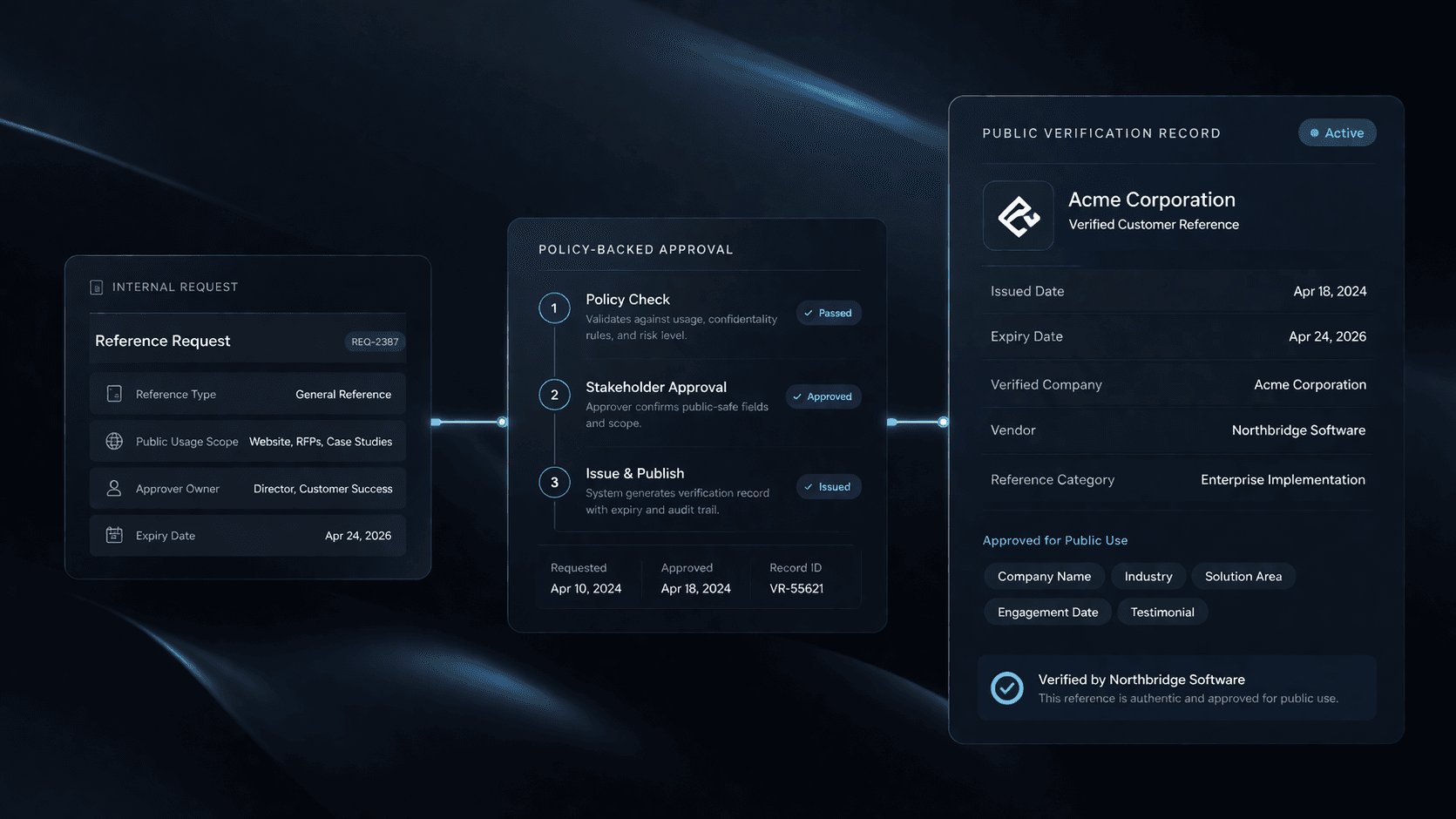
Trust the reference surface
Replace static case-study claims with an active verification system stakeholders can trust.
Control who can approve
Route authorizations through accountable approvers, with expiry rules and revocation triggers.
Keep records audit-ready
Every approval, change, and removal is captured in a clear, reviewable timeline.
What OBAM is and is not.
OBAM is lifecycle governance for public references, not a one-time internal approval step.
| Comparison | OBAM model | One-time/internal model | Evidence |
|---|---|---|---|
| OBAM vs DAM | OBAM governs public reference claims through an ongoing lifecycle: approvals, revocation control, and externally visible verification output. | DAM systems are built for asset storage and internal distribution, typically without a public authorization lifecycle and revocation-backed verification surface. | See docs |
| OBAM vs CMS approvals | OBAM keeps governance active after publication by tracking status changes and reflecting current authorization on verification pages and outputs. | CMS approvals usually end at publish time and are internal workflow checkpoints, not continuous governance with revocation and public verification. | See verification surface |
| OBAM vs reference management | OBAM links each public claim to accountable lifecycle governance, including revocation and evidence-ready verification output for external review. | Reference management is often relationship coordination for point-in-time use, not legal-grade lifecycle control for ongoing public authorization status. | See legal solution |
Why teams replace unmanaged reference pages
Static logo walls and ungoverned case-study pages quickly drift away from legal terms, partner status, and approved language. OBAM creates a control layer so every public reference claim can be traced to explicit authorization, expiry dates, and accountable owners.
- Prevent stale “customer of” claims from persisting after contracts, scopes, or consent terms change.
- Give procurement and security reviewers a verifiable status surface, not unverifiable screenshots.
- Connect legal controls to day-to-day marketing and partnerships publishing workflows.
Role-based outcomes from one governance system
For legal and IP
Enforce policy-backed approvals and maintain defensible audit records across authorization, renewal, and revocation.
Explore legal governance controlsFor brand and partnerships
Publish only approved logo and relationship language while staying aligned to current agreement reality.
See brand governance workflowsFor procurement and security
Review public verification pages that show active, expired, or revoked status before making trust decisions.
Review procurement verification approachProcess: from request to public verification in four stages
The full lifecycle view shows intake, approval, publication, and ongoing governance in one system of record.
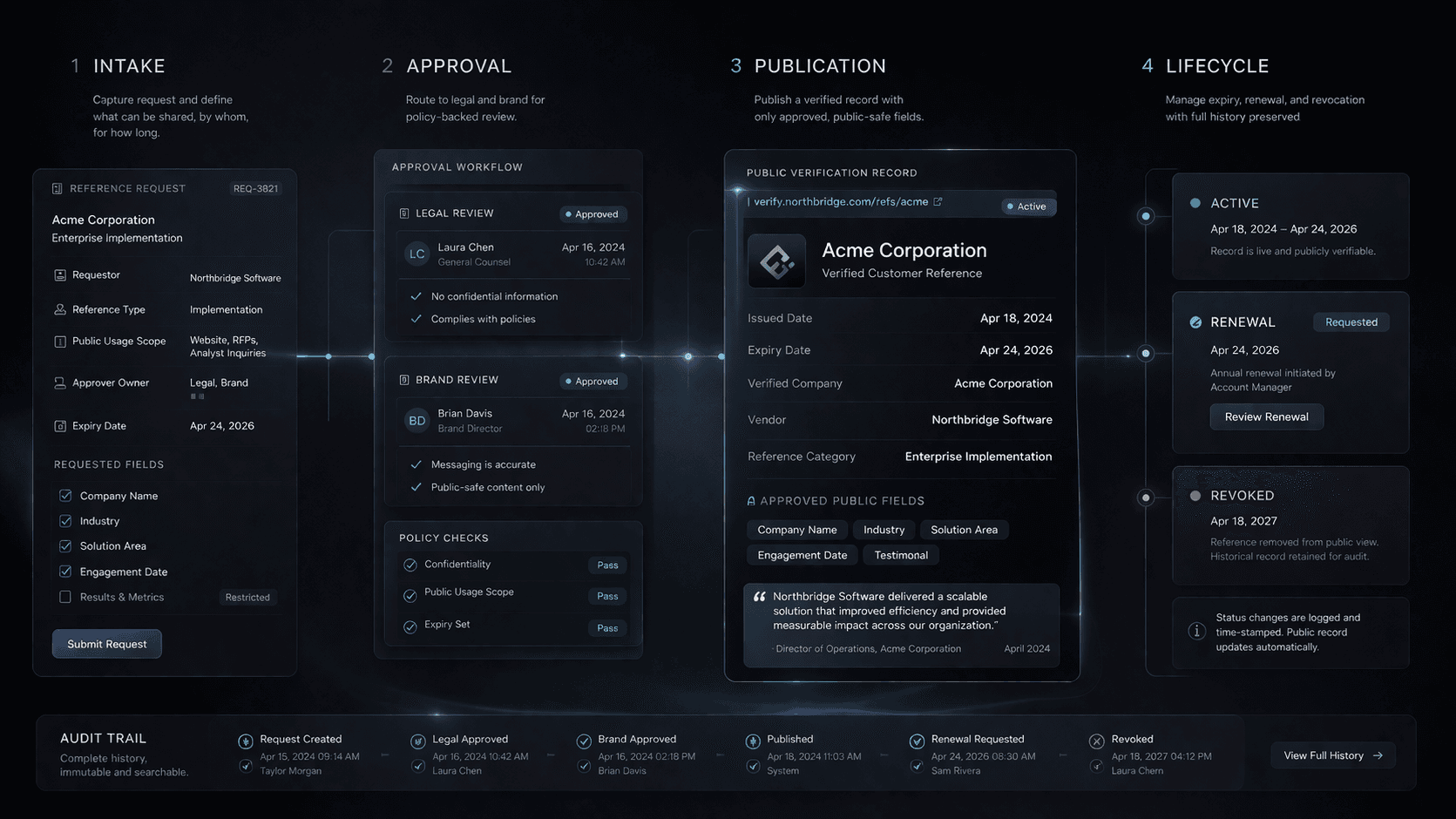
1) Intake
Submit logo, testimonial, case-study, or partnership requests with scoped public usage intent.
2) Approval
Route each request to legal, brand, or relationship owners based on policy and role.
3) Publication
Expose approved, public-safe fields on hosted verification pages and JSON endpoints.
4) Lifecycle
Apply renewals, expiries, and revocations so status always reflects current authorization state.
Trust proof and rollout confidence
Auditable history
Every reference claim keeps timestamped lifecycle records for internal and external review.
Public-safe output
Share only approved fields while preserving internal context and decision evidence.
Policy-first rollout
Start with one team or one workflow, then expand controls across your reference surface.
What external reviewers can verify
Public verification pages and machine-readable output at /verify/[slug].jsonexpose current lifecycle state so procurement, legal, and security reviewers can validate reference claims against explicit status evidence.
Active
Reference is currently authorized for the approved use case and can be relied on as valid proof.
Expired
Authorization window ended; claim remains in history but should not be treated as currently approved.
Revoked
Authorization was withdrawn before or after expiry and should be considered explicitly not authorized.
Built for high-stakes customer reference moments
Enterprise security and procurement reviews
Give buying teams clear, current, and auditable proof of relationship claims before they treat public references as diligence signals.
Partner ecosystem and marketplace listings
Keep partner directories and alliance pages aligned with current agreement language, approved relationship type, and revocation policy.
Sales enablement and regional marketing campaigns
Ensure case studies and testimonials stay within approved channels, geographies, and validity windows as campaigns expand.
Ongoing legal and IP governance operations
Turn reference control from ad hoc exceptions into a repeatable legal operations process with role-based accountability.